AZ-0007 · Oracles
Solar System Orrery
Legend
The planets and Pluto
| Body | Kind | Distance from the Sun (AU) | Orbital period | Moons shown |
|---|---|---|---|---|
| Mercury | Planet | 0.39 | 88 days | none shown |
| Venus | Planet | 0.72 | 225 days | none shown |
| Earth | Planet | 1.00 | 365 days | 1 |
| Mars | Planet | 1.52 | 1.9 years | 2 |
| Jupiter | Planet | 5.20 | 11.9 years | 4 |
| Saturn | Planet | 9.54 | 29.5 years | 2 |
| Uranus | Planet | 19.19 | 84.1 years | 1 |
| Neptune | Planet | 30.07 | 165 years | 1 |
| Pluto | Dwarf planet | 39.48 | 248 years | none shown |
Comets, interstellar visitors and asteroids
Switch on the comets to see Halley and C/2023 A3, and the two visitors from other stars. Apophis and Psyche are always shown, in the colours of the legend.
| Body | Kind | About it |
|---|---|---|
| Halley | Comet | The best known comet. It returns every 75 or 76 years; its last perihelion was in February 1986. |
| C/2023 A3 | Comet | Comet Tsuchinshan-ATLAS, which passed the Sun in September 2024 on a path that will not bring it back for tens of thousands of years. |
| 3I/ATLAS | Interstellar object | The third object found passing through the solar system from another star. It reached its closest point to the Sun in October 2025. |
| ’Oumuamua | Interstellar object | The first known interstellar visitor, found in 2017 and already leaving. |
| Apophis | Near-Earth asteroid | A near-Earth asteroid about 340 metres across that will pass closer than our satellites on 13 April 2029. |
| Psyche | Metal asteroid | A main-belt asteroid thought to be mostly iron and nickel, perhaps a planet's exposed core. |
About this orrery
An orrery is a working model of the solar system, and this one runs in your browser. I built it so you can watch the planets keep their places: Mercury racing round in 88 days while Neptune takes 165 years to go once. Pick any date from 1 January 1800 to 31 December 2050, speed time up or run it backwards, follow a planet, a comet or an asteroid as it moves, and copy a link that opens the same view for someone else.
What is exact, and what is scaled
Exact, to the accuracy of the published elements: each planet's orbital period, the shape and tilt of its orbit, and where it is along that orbit on the date you choose. I use the approximate Keplerian elements that NASA's Jet Propulsion Laboratory publishes for 1 January 1800 to 31 December 2050. They are close enough to show a planet in the right part of its orbit, but they are not an ephemeris, and the page does not claim precision to the arcsecond. Dates outside that range are moved to its nearest edge, and the page tells you when that happens.
- Scaled: the sizes of the bodies. Real planets would be invisible at this scale, so each is drawn many times too large.
- Scaled: distance from the Sun. A body that is r astronomical units out is drawn at the square root of r, so Mercury and Neptune fit in one view. Directions from the Sun are true; relative distances are not.
- Simplified: the moons. Their periods are real, but they travel in circles at a drawn radius, from an arbitrary starting point (11 moons, listed in the table below).
- Approximate: comets, interstellar visitors and asteroids use rounded orbits. Apophis is placed so that it passes Earth on 13 April 2029; Psyche's place along its orbit is only illustrative.
- Decorative: the asteroid belt is a field of dots, and the stars are fixed.
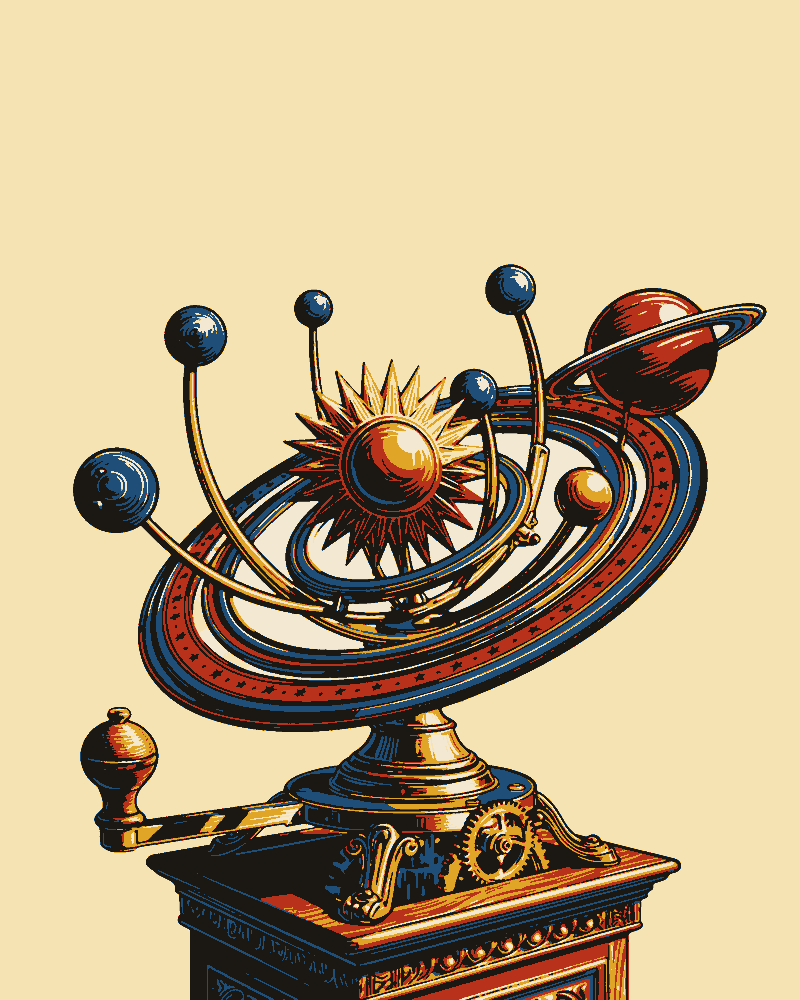
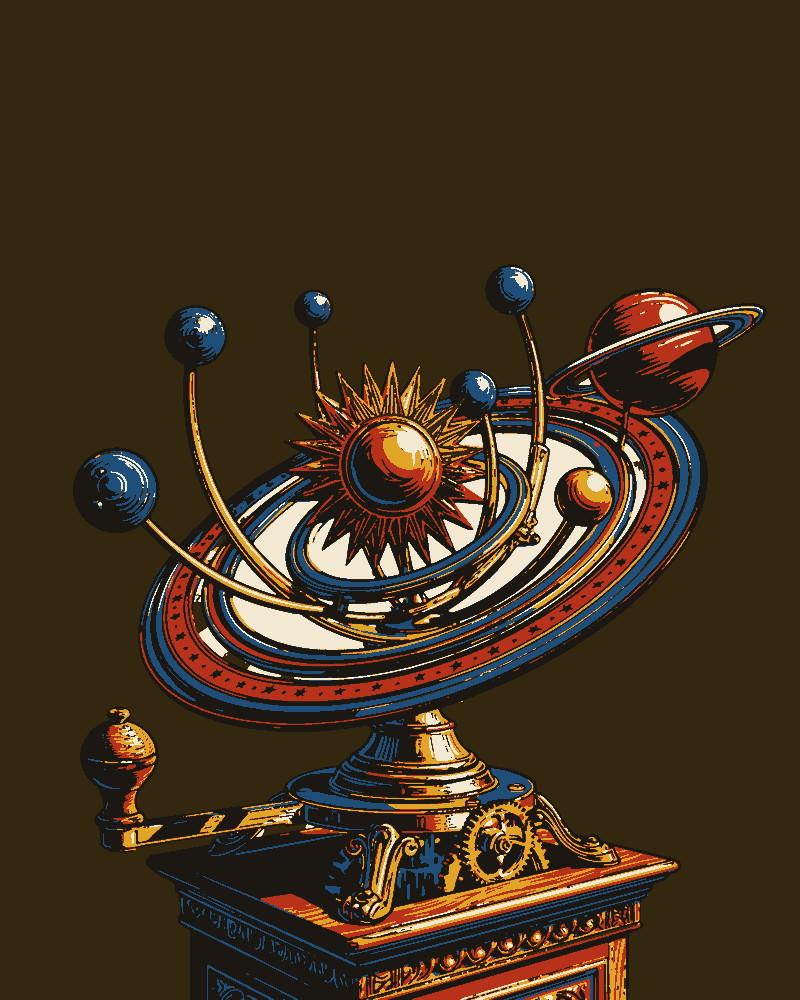
Solar System Orrery
Planetarium horologica
- Kingdom
- Oracles
- Order
- Orreries
- Habitat
- Browser
- Diet
- Dates
- Status
- New acquisition
Watch the planets move on a 3D orrery. Jump to any date from 1800 to 2050, change the speed, follow a body, and share a link to the exact view.
Field notes
See the next exhibit before it goes on display.
One email when a new exhibit joins the cabinet, and nothing else.
I use your address only to email you when a new exhibit joins the cabinet. I never sell or share it, and you can unsubscribe any time. Privacy details